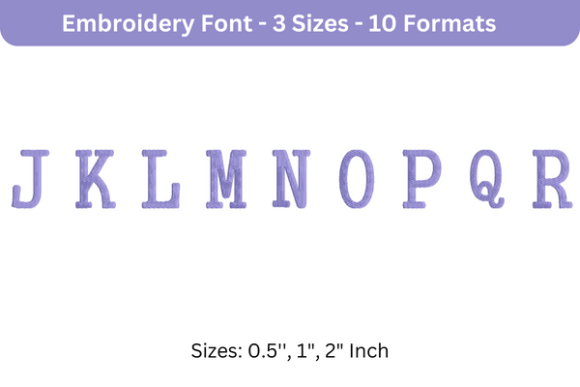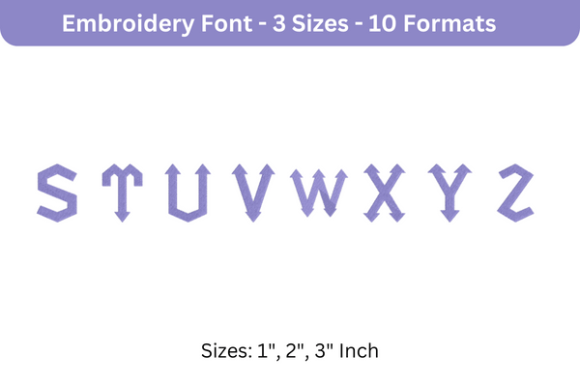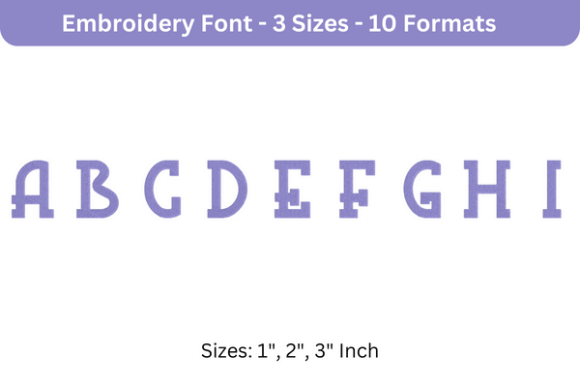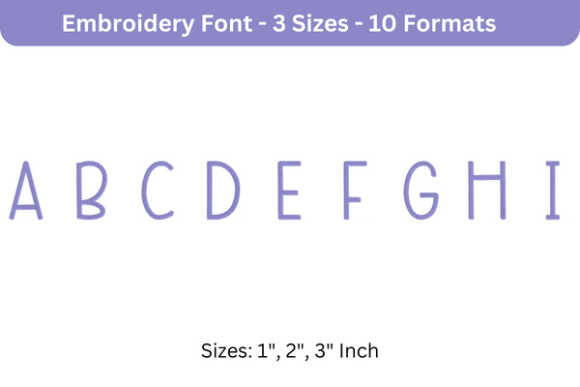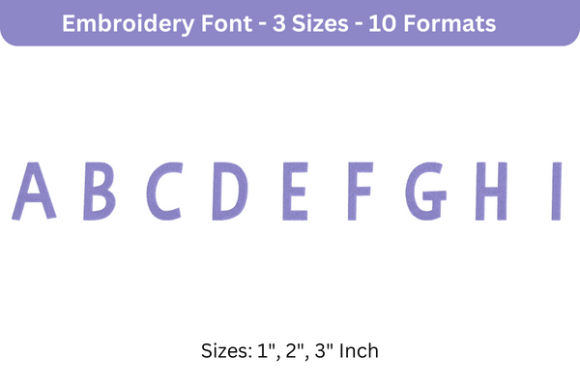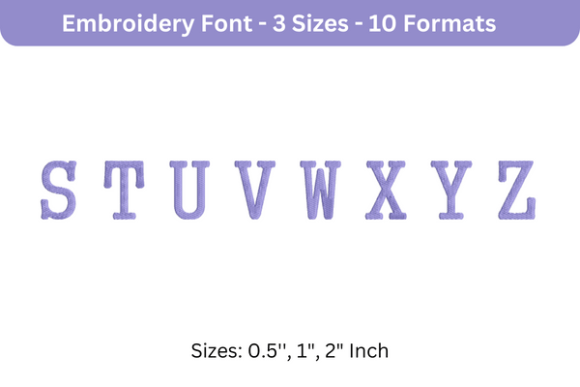
Executive Font Uppercase S to Z
Executive Font Uppercase S to Z is more than a set of letters—it’s a refined, stitch-precise embroidery font designed for clarity, consistency, and quiet authority. Unlike decorative or script-based machine embroidery fonts, this collection focuses exclusively on clean, uppercase characters from S through Z—each letter engineered for optimal thread flow, balanced density, and sharp edge definition. It’s built for professionals who value legibility at small scales, creators who embroider on structured fabrics like twill or denim, and small businesses personalizing apparel, corporate gifts, or commemorative textiles.
Why Precision in Letterforms Matters More Than Ever
Today’s embroidery workflows are faster, more connected, and increasingly integrated with digital design tools—but speed means little without reliability. A single misstitched “S” or uneven “Z” can disrupt the entire visual rhythm of a monogrammed tote bag, a graduation cap, or a custom lab coat. Executive Font Uppercase S to Z addresses this by prioritizing structural integrity: consistent stroke weight, generous counter spaces, and optimized jump-stitch placement. These aren’t aesthetic choices made in isolation—they’re responses to real-world challenges like fabric shifting under high-speed hoops, tension inconsistencies across multi-needle machines, and the growing demand for crisp text on textured or stretchy substrates.
Consider how expectations have shifted: consumers no longer accept “good enough” personalization. A boutique selling embroidered baby blankets expects flawless “ZOE” on a 3-inch hoop. A university bookstore needs “STANFORD” rendered clearly on performance fleece. An HR team ordering branded polos for remote onboarding wants names that read cleanly on camera during virtual welcome sessions. Executive Font Uppercase S to Z meets those expectations—not by adding flash, but by removing friction.
Designed for Real Machines, Not Just Mockups
This isn’t a vector font converted post-hoc into embroidery files. It’s a native machine embroidery design, developed with stitch logic embedded from the start. Each character includes underlay stitches tailored to letter geometry—tight zigzags beneath curves, light tatami fills for straight segments—to prevent puckering and ensure stability across cotton poplin, canvas, and even lightweight wool blends.
The package includes multiple file formats: PES (for Brother and Baby Lock), DST (for Tajima and Melco-compatible machines), JEF (for Janome), EXP (for older Bernina models), and VP3 (for Viking and Pfaff). That breadth matters because embroidery professionals rarely use just one machine—and studios often inherit legacy hardware alongside newer models. Having all formats in one download eliminates format-conversion guesswork, version mismatches, or last-minute file re-digitizing before a client deadline.
How It Fits Into Modern Creative and Business Workflows
Personalization has moved beyond novelty into necessity. Whether it’s a freelancer branding their own gear, an educator embroidering classroom supplies with student names, or a wedding planner sourcing custom napkins and robe sets, the ability to add meaningful, readable text quickly and confidently is now table stakes—not a premium add-on.
What’s changed isn’t the desire for customization, but the expectation of scalability. A craftsperson who once hand-embroidered initials on five jackets a week may now manage 50+ orders monthly via Etsy or Shopify integrations. That volume demands repeatable, predictable results—and fonts that behave the same way across batches. Executive Font Uppercase S to Z delivers that consistency. Its uniform baseline alignment and consistent character width simplify spacing calculations in digitizing software, reducing manual kerning time. For users of AutoPunch or similar auto-digitizing tools, its clean outlines also yield cleaner, more accurate conversions when adapting logos or initials.
Practical Uses Across Contexts
Here’s where this font proves its versatility—not as a “one-size-fits-all,” but as a purpose-built solution for specific, recurring needs:
- Corporate and academic wear: Embroidering department names (“SCHOOL OF ENGINEERING”), faculty initials, or event dates on blazers and lanyards—where readability at arm’s length is non-negotiable.
- Life milestone items: Baby onesies (“SAMUEL”), graduation stoles (“ZAHRA”), or retirement banners (“SEAN”)—where emotional resonance depends on clean, dignified presentation.
- Small-batch product branding: Labels on handmade totes, tea towels, or aprons—where subtle, professional typography reinforces brand trust without overwhelming the item’s function.
- Educational tools: Classroom charts, tactile learning aids for early literacy, or sensory-friendly name tags—where consistent shape recognition supports cognitive processing.
Note: While Executive Font Uppercase S to Z covers S–Z, it’s intentionally part of a larger, modular system. Many users pair it with complementary fonts covering A–R for full-name applications—or use it standalone when only later-alphabet names, acronyms, or thematic words (“SUCCESS,” “ZENITH,” “SYNERGY”) are needed. This modularity reflects how modern creators work: not with rigid templates, but with adaptable, interoperable assets.
Choosing the Right Font Is a Workflow Decision
It’s easy to overlook typography in embroidery—after all, thread and fabric dominate the physical outcome. But experienced digitizers know that poor letterform structure leads directly to higher thread breaks, more frequent bobbin changes, and increased re-hooping. Executive Font Uppercase S to Z minimizes those variables through deliberate design choices: moderate height-to-width ratios (avoiding overly narrow “I”s or wide “W”s), rounded terminals instead of sharp points (reducing needle stress), and optimized satin column widths for smooth, dense edges.
That attention translates into tangible time savings. One small-business owner reported cutting average setup time per personalized item by 22% after switching from a generic freeware font—mostly due to fewer test stitches, less thread trimming between letters, and reduced need for stabilizer adjustments. Another educator using it for 30+ student name tags noted zero skipped stitches across three different fabric types—something she hadn’t achieved with previous fonts.
Not Just for Experts—But Built to Grow With You
You don’t need years of digitizing experience to benefit from Executive Font Uppercase S to Z. Its straightforward naming convention (e.g., “EXEC_S_PES”, “EXEC_Z_DST”) makes file selection intuitive. Its consistent sizing—measured in standard embroidery units—means scaling is predictable: double the size, and you reliably double the stitch count without distortion. Even beginners using basic editing software like PE-Design Nano or Embrilliance Express can layer it cleanly over motifs or adjust spacing without breaking the design.
At the same time, advanced users appreciate the underlying flexibility: stitch density is calibrated for 40-weight rayon or polyester thread, but easily adapts to 60-weight for finer detail or 30-weight for bold visibility. The underlay is present but minimal—leaving room for custom stabilization strategies without over-engineering.
A Thoughtful Tool in a Noisy Landscape
In a market flooded with ornate, over-digitized fonts promising “instant luxury,” Executive Font Uppercase S to Z stands apart by embracing restraint. It doesn’t shout. It clarifies. It supports intention rather than competing with it. That makes it especially valuable for professionals whose work centers on communication—whether it’s a therapist embroidering affirmations on mindfulness cushions, a nonprofit personalizing donor thank-you scarves, or a tech startup adding subtle branding to swag.
Its relevance isn’t tied to a passing trend. It’s rooted in enduring needs: clarity, consistency, compatibility, and quiet confidence in execution. As more people turn to embroidery—not just as a hobby, but as a tool for expression, identity, and connection—that kind of reliability becomes indispensable.