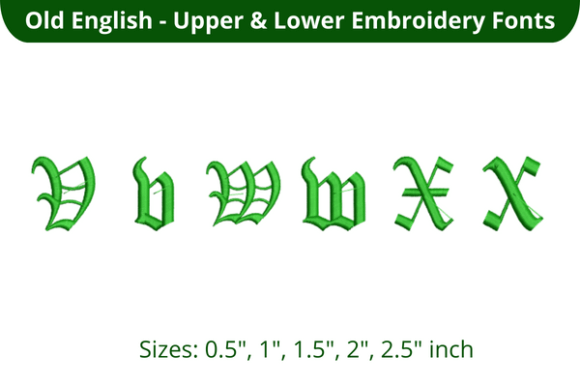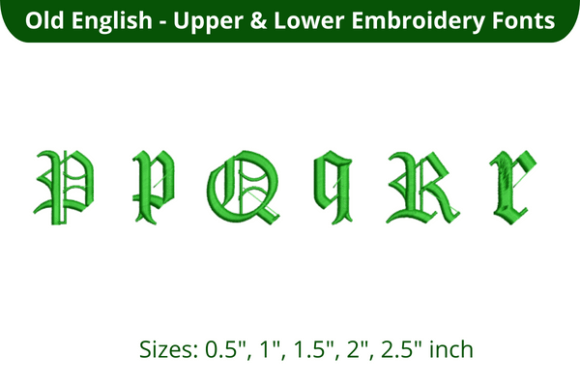
Old English Font YZ: Embroidery That Feels Timeless, Not Trendy
If you’ve ever stitched a monogram onto a baby blanket and paused—wondering why it looks crisp but somehow lacks soul—Old English Font YZ might be the quiet upgrade your embroidery projects need. It’s not just another decorative font. It’s a high-quality machine embroidery design built for clarity, tradition, and quiet confidence—especially when you’re stitching names, dates, or short quotes onto fabric that matters.
What Makes Old English Font YZ Different From Other “Vintage” Fonts?
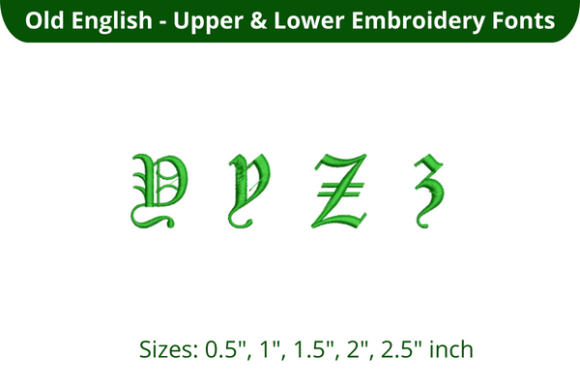
Many fonts labeled “Old English” lean too heavy, too dense, or too ornate—making them hard to stitch cleanly on lightweight cotton, linen napkins, or even denim jackets. Old English Font YZ strikes a thoughtful balance: its letterforms are authentically rooted in historical calligraphy, but they’re digitized with modern embroidery precision. That means fewer thread breaks, smoother satin stitches, and legible results—even at sizes as small as 1.5 inches tall.
It comes pre-packaged in multiple embroidery file formats (.dst, .pes, .jef, .exp, .vp3, .xxx) so whether you’re using a Brother Innov-is, Janome Memory Craft, Bernina 790, or even a commercial Tajima-compatible system, you won’t need to convert files manually—or risk losing detail in translation.
Personal Keepsakes That Actually Keep Their Meaning
Think of a newborn’s first blanket—embroidered with their name and birth date. A generic script font might look pretty, but Old English Font YZ adds warmth without fussiness. Its balanced spacing and subtle serifs hold up beautifully on terry cloth or flannel, where tight loops or overly thin strokes would vanish into the pile. Same goes for heirloom christening gowns or wedding handkerchiefs: it reads like care, not clutter.
Small-Business Branding That Doesn’t Shout
A local apothecary embroiders muslin drawstring bags with herbal blend names—“Lavender & Chamomile,” “Rosemary & Sage.” Using Old English Font YZ gives those labels texture and authenticity, aligning with handmade aesthetics without leaning into cliché. It’s subtle enough for repeat branding (think shop towels, aprons, or gift tags), yet distinct enough that customers remember the feel of your label—not just the logo.
Educational & Community Projects With Quiet Authority
A middle school textile arts teacher uses Old English Font YZ to stitch class mottoes onto woven wall hangings (“Make Thoughtfully,” “Stitch With Purpose”). Students notice how each letter stands on its own—no overlapping, no confusing flourishes—and that builds early confidence in reading and reproducing letterforms by machine. It also scales well for mixed-ability groups: beginners can use the larger size files; advanced students layer it with fill-stitch backgrounds or combine it with simple border motifs.
Wedding & Event Details That Feel Intentional
No one wants place cards that look like they were printed from a 2004 WordArt template. Old English Font YZ offers dignity without stiffness. When stitched onto linen napkin corners or cotton table runners, it grounds the setting—elegant but approachable. And because it’s available in multiple sizes and densities, you can adapt it for delicate organza escort cards (lighter stitch count) or thick wool table numbers (reinforced underlay).
Real Things to Consider Before You Stitch
Old English Font YZ shines brightest when used intentionally—not as filler, but as punctuation. Here’s what works (and what doesn’t):
- Best for short text: Names, initials, dates, mottos, or single-line quotes (e.g., “Est. 2022,” “The Smiths,” “Grow Slowly”). Avoid full paragraphs—it’s not designed for body text.
- Fabric matters more than you think: It performs exceptionally well on stable weaves (cotton poplin, twill, medium-weight linen). On highly stretchy knits or loosely woven burlap, stabilize generously—and test stitch first. The font’s structure holds up, but the fabric has to cooperate.
- Thread choice changes the tone: Matte cotton or rayon gives soft contrast on light fabrics; metallic or variegated thread adds dimension on darker backgrounds—but don’t overdo it. The font’s strength is its readability, not flash.
- Machine settings matter: Use standard needle (75/11 or 80/12) and slow-to-moderate speed (especially on curves or tight serifs). Let the design breathe—don’t crowd it with dense fill stitches nearby.
Who Benefits Most—and How They Use It Differently
A freelance surface pattern designer might use Old English Font YZ to add subtle brand signatures to fabric swatch books—stitched discreetly along the selvedge. It becomes part of her visual language, not an afterthought.
A homeschool parent uses it to personalize history notebooks—stitching “1066” or “Magna Carta” onto cloth covers. Kids connect the look of the font to the era they’re studying, making typography part of the lesson—not just decoration.
A boutique hotel embroiders guest robes with room numbers in Old English Font YZ. It feels bespoke, not corporate—warm, memorable, and quietly consistent across 42 rooms.
Even digital creators benefit: bloggers documenting DIY home goods often photograph embroidered linens for social posts. Old English Font YZ photographs well—clean lines, strong contrast, no pixelation or blur—even in natural light on textured backgrounds.
It’s Not About Nostalgia—It’s About Intention
Old English Font YZ doesn’t ask you to recreate the past. It gives you a tool to mark moments with presence: a child’s first stitch kit, a shop’s opening day banner, a teacher’s retirement gift. Its value isn’t in how “old” it looks—but in how clearly it says, This matters.
You don’t need vintage inspiration to use it well. You just need a reason to make something last longer than a trend—on fabric, in memory, or in meaning.