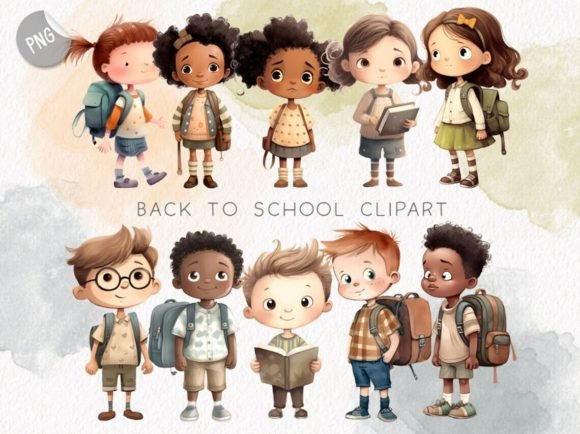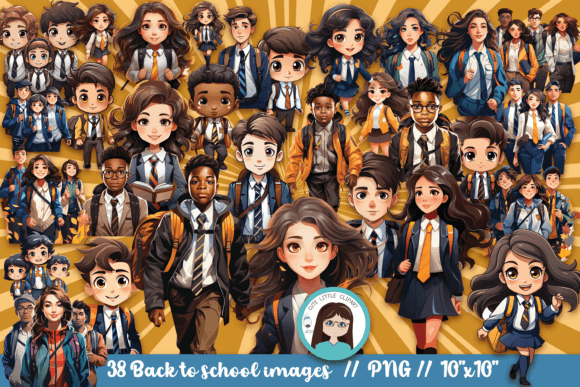
Back to School Children PNG Image Collection
Back to School Children refers to a curated set of 38 high-resolution PNG illustrations depicting diverse children in educational settings. Each image features a transparent background, is rendered at 300 DPI, and measures 10 × 10 inches—making them suitable for both print and digital use. The collection emphasizes authenticity and inclusivity, portraying students across ages, ethnicities, abilities, and learning contexts: from children adjusting backpacks on a sunlit sidewalk to small groups collaborating at classroom tables or raising hands during lessons.
Why This Collection Matters for Content Creators
Educators, curriculum designers, marketing professionals, and nonprofit communicators often need visual assets that reflect real-world classroom diversity while maintaining technical flexibility. Back to School Children addresses this need by offering ready-to-use, royalty-free illustrations that avoid stock-photo clichés. Unlike generic clipart or AI-generated imagery, these handcrafted visuals prioritize expressive detail—subtle gestures, natural postures, and contextual accuracy—that support emotional resonance without sacrificing clarity.
Key Benefits for Practical Use
- Transparency and Compatibility: The PNG format with transparent backgrounds allows seamless layering over presentations, worksheets, websites, or social media graphics—no cropping or masking required.
- Consistent Quality and Scale: All 38 images share uniform resolution (300 DPI) and dimensions (10 × 10 inches), simplifying layout planning and ensuring sharp output across formats—from A4 handouts to large-format posters.
- Inclusive Representation: Characters reflect varied skin tones, hair textures, clothing styles, and physical abilities. Some images include assistive devices or culturally specific attire, supporting equitable messaging in educational or community-facing materials.
- Contextual Versatility: Scenes span transitional moments (entering school grounds), active learning (reading, drawing, experimenting), and social interaction (sharing supplies, group discussion)—enabling visual storytelling across multiple phases of the school year.
Tradeoffs and Considerations
While Back to School Children offers strong utility for many use cases, it’s important to recognize its scope and limitations. First, the collection is illustration-based—not photographic. Users seeking documentary realism or hyper-detailed environmental context may find the stylized approach less suitable for certain applications, such as photojournalistic reports or highly specific curriculum simulations (e.g., lab safety procedures requiring precise equipment depiction).
Second, the fixed 10 × 10 inch size means resizing downward for web thumbnails or mobile interfaces is straightforward, but significant enlargement beyond native dimensions may reveal pixelation—though 300 DPI supports standard print sizes up to tabloid without loss.
Third, while diversity is intentionally represented, the set does not include every possible identity marker (e.g., specific religious head coverings, rare medical devices, or regional school uniforms). Users with highly specialized representation goals should review the full preview set before purchase to assess alignment with their audience’s needs.
When This Collection Is a Strong Fit
Back to School Children works especially well for educators developing original lesson resources—such as editable PowerPoint slides, interactive PDFs, or printable behavior charts—where consistent, clean visuals reinforce learning objectives without distracting clutter. Its transparency and resolution also make it ideal for designers building branded back-to-school campaigns: email headers, newsletter banners, or landing pages for tutoring services, school supply retailers, or PTA communications.
Nonprofits focused on literacy, equity in education, or family engagement may benefit from the collection’s emphasis on warmth and accessibility. Because the images avoid exaggerated expressions or cartoonish exaggeration, they lend credibility to advocacy materials aimed at policymakers or grant reviewers who value respectful, grounded visuals.
When Alternatives May Be Worth Exploring
If your project requires photorealism—for example, illustrating a district-wide safety initiative where exact uniform colors or facility architecture must be accurate—licensed photography or custom photo shoots may deliver more precise fidelity. Similarly, if you need animated sequences (e.g., for an educational app tutorial), static PNGs won’t meet that functional requirement; SVG-based vector illustrations or motion graphics would be more appropriate.
For users needing frequent updates or seasonal variations (e.g., winter-themed classrooms or holiday activities), a one-time collection like Back to School Children offers limited scalability. Subscription-based illustration libraries or platforms offering editable vector assets might better serve long-term, evolving content strategies.
Making an Informed Decision
Before selecting Back to School Children, consider three practical questions:
- What is the primary output medium? If most deliverables are printed handouts, newsletters, or laminated classroom aids, the 300 DPI resolution and transparent layers provide clear advantages. For fast-turnaround social media posts where file size matters, verify that exported PNGs meet platform upload limits (most will, given typical compression).
- How critical is representational nuance? Review individual image previews for alignment with your audience’s demographics and values. Does the set include characters whose appearance or activity resonates with your learners’ lived experiences? If not, supplemental assets may be needed.
- What is your editing workflow? Because these are raster images, advanced edits (e.g., changing clothing color or swapping facial expressions) require photo-editing software and skill. Users relying heavily on quick, template-driven design tools (like Canva or Google Slides) will find the transparent backgrounds highly compatible—but those needing deep customization should factor in editing time.
Finally, assess longevity. While trends in illustration style evolve slowly, the timeless focus on genuine student engagement—rather than dated fashion or technology—means this collection remains relevant across multiple academic years. It avoids fleeting motifs (e.g., oversized smartphones or specific gadget brands) in favor of enduring themes: curiosity, collaboration, and growth.
Ultimately, Back to School Children serves as a purpose-built tool—not a universal solution, but a thoughtful resource for those prioritizing inclusive, technically sound, and emotionally grounded visuals in education-adjacent work. Its value emerges most clearly when matched to concrete goals: reducing production friction, strengthening audience connection, and honoring the varied realities of learning environments.